What I Loved About Gabrielle Union's 'We're Going to Need More Wine'
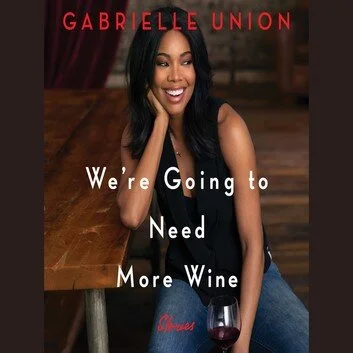
Hey Y’all! I finished Gabrielle Union’s book, We’re Going to Need More Wine, and though I said I wouldn’t, I decided to go ahead on and make a post about it. She was incredibly raw, honest and vulnerable in this book, and I’d be remiss if I didn’t share how it resonated with me.
I’ve highlighted the most memorable chapters and talked a little bit about why they were important to me. I hope you enjoy.
1) “The Step Mother”- One thing that stuck with me about this chapter is Gabrielle’s motherhood in proximity to Blackness. Even though she is famous, she is still plagued by some of the same social realities and anxieties for her sons and Dwayne that we have about our sons, nephews, fathers, uncles, brothers, and cousins. I realized this at two points in this chapter:
The first was when she talks about how she handles issues at school.
“When I go to school meetings, I come with books and articles to support what I’m talking bout. Whether it’s a Harvard study on implicit bias in academia or research into African American teenagers underperforming because they go to school with the burden of suspicion, I was ready to call them on their shit” (p. 210).
Though I really hate the idea of my children experiencing racism, I aspire to this level of Black, woke motherhood, when it comes to addressing both conscious and unconscious bias on their behalf.
The second point was when she addresses how she still carries the weight of protecting her kids from police brutality in spite of being a prominent black actress. I mean down to the way they - the kids - are required to walk their dog. In a conversation with her sons she tells them, “Wrap the dog leash around your thumb. That way, your fingers are free to spread.” In her mind, if their fingers are spread, there’s no way a police officer could possibly think they had anything else in their hand, mitigating the recurrence of all the horrible things that have happened to Black people in recent years and all times. Again, this was just to walk to walk the dog, but as she says in the book, “this is what you did three years after Trayvon Martin and five months after Tamir Rice” (p.215).
I was shook. We sometimes like to think that celebrities are removed from the every day realities of common people, but reading this humanized her a bit more.
2) Black Women Blues - I really appreciated this chapter because she addresses colorism from a holistic perspective, meaning the way dark-skinned people are affected but also the way light skinned people are affected as well. This was important, because in the colorism discourse among Black Twitter, it often gets lost in translation that light-skinned Black people are still Black, fighting for the same. damn. cause.
Just to put the facts out there, she drops some knowledge and validates the hell of out the plight of dark-skinned people so that whatever you thought, isn’t.
“…Sociologists like Margaret Hunter have collected real empirical evidence that we are color struck. Darker-skinned people face a subset of racial inequalities related to discipline at school, employment, and access to more affluent neighborhood. In one study, Hunger found that lighter-skinned women earned on average twenty-six hundred dollars more a year than her darker sister.
Honestly, that was only a piece of that conversation. She talks about how she wouldn’t date anyone darker than her for awhile; how her fake friend would tell her “it was great” that she could book jobs even though she was dark; she even tells us how some of the Black men she dated shamelessly admitted that “lightening up [their] gene pool” was their main goal implying that dating her just wouldn’t have been an option. SICK.
The next thing is this: as a teenager, this deeply rooted value system - which by the way no Black person ever had anything to do with from the jump - impacted her so much that her platonic relationships were even affected. She essentially hated any light-skinned girl she felt could get the attention of boys she liked. In her words, “[she] disliked them on sight.”
The irony here is that Gabrielle’s mom, who is light-skinned, basically received the same treatment Gabby admits to giving light skinned girls from her own darker-skinned peers. As a result, she went on to marry a darker man so that her kids(i.e. Gabrielle) could avoid the “light-skinned problems” she faced growing up.
Anybody need reparations yet?
I loved this chapter so much, because it explores so many of the complexities around colorism, but there’s nothing my summary could do to give it justice. I’m going to just share these two other quotes that resonated and move on to the next bullet:
“We darker skin girls should not be pitted against our lighter skinned sisters, but out pain at being passed over also should not be dismissed by people saying, “Love the skin you’re in.” You can love what you see in the mirror but you can’t self esteem your way out of the way the world treats you.”
“For a Black girl you sure are pretty!” This is the white cousin of "pretty for a dark-skinned girl.” To fully understand colorism, we have to acknowledge the root. Just as dark-skinned girls are often only deemed deserving of praise despite their skin tone, black women as a whole are often considered beautiful despite their blackness.
3) The Room Where it Happens - I’ll be quick on this one. So, Gabrielle Union got invited to an invite-only party hosted by Prince. To be clear, all parties hosted by Prince were invite-only(no plus one) and she got invited. It was a big deal!
Anyway, while she was there she made a ton of connections with people, who because of their experience that night, began to vouch for her, when it came time to get booked for acting roles. Essentially, she reminds us how important it is to not only get access to the “room” but also how it’s important to maximize those opportunities and build relationships. I love to see it.
4) Crash-and-Burn Marriage - Ya’ll, my takeaway here was this: Do not force it. In this chapter, Gabi - and I can call her this now because after reading all about her life, we’re cousins af - tells us that she dated an NFL player all of 3 months before agreeing to become his wife. Mind you, she found out he was a cheater the literal day after he proposed and stayed with him anyway.
…For someone with an intense fear of public humiliation, who just hours ago felt lucky to have been chosen, I had no choice but to stay. I didn’t have it in me to call all those people twenty four hours later to say “You were right.” Because then everyone would know just how naive and foolish I really was.
I’m personally grateful she shared all of what she did in this chapter. From funding his education/life, accepting his triflin ways and lowering her barometer of happiness to divorcing an unfaithful husband, she makes it vividly clear what can happen when you proceed down a road you know better than to take anyway. Read the chapter. Learn from Gabi.
5) Get Out of My P*ssy - This was one of the most thought-provoking chapters. It was the episode of Being Mary Jane, where she struggles to get pregnant, but only this time it was written and it was a real life story. For whatever reason, she was having issues with her hip, so she went to the hospital to get an MRI.
In order to be seen, she had to fill out a form where she denoted she was not pregnant, but more than 3 nurses came into her back to back asking her anyway, “are you pregnant.” “You and Wade would have such pretty babies,” another said.
The gag? The Wades had already had 8 or 9 miscarriages at this point.
For three years my body has been a prisoner of trying to get pregnant — either been about to go into an IVF cycle, in the middle of an IVF cycle or coming out of an IVF cycle. i have endured eight failed IVF cycles with my body constantly full of hormones, and as you’ve probably figured out by now, yes, I am constantly bloated from these hormones. (It also means I have forgotten my normal baseline emotional reaction to any given situation, and have no idea whether it would resemble my I’m-going-to-hop-off-the-roof reaction.) page 198
Bottom line, reading this made it painstakingly clear that it can be incredibly difficult for families to conceive, and we just need to be mindful about not asking women when they’re going to have kids. Many of us mean well, but there are a lot of people enduring emotional and mental turmoil, asking themselves the same question: when will they get pregnant.
Definitely going to put a pin in my mouth the next time I get an inkling to ask.
Overall, I didn’t have many expectations for this book, but as I read the parables she shares, I began to have so much appreciation for Gabrielle Union and her life. If you can, get the book and jump right into it.
A tip? Grab a little something to go along with the read. ;)